
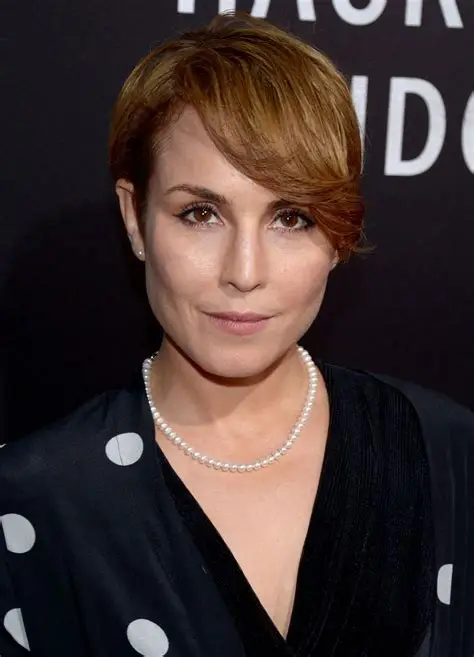
Noomi Rapace has built an international acting career through physically demanding roles, complex female characters and performances in major film productions. The Swedish actress gained worldwide recognition as Lisbeth Salander in the original Millennium film trilogy before moving into Hollywood productions such as Prometheus, Sherlock Holmes: A Game of Shadows and What Happened to Monday.
In November 2026, Rapace expanded her career beyond acting with the launch of Boom Films, a production company she co-founded with producer Stella Härnström. Based in Stockholm and London, the company will develop female-driven film and television projects across action, thrillers, horror, supernatural stories and arthouse cinema.
Her move into production marks another stage in a career that has increasingly involved shaping the stories she wants to bring to the screen.
Noomi Rapace Biography and Early Life
Noomi Rapace was born on December 28, 1979, in Hudiksvall, Sweden. Her birth name was Noomi Norén. She grew up in a family connected to the performing arts through her mother, Nina Norén, a Swedish actress, and her father, Rogelio Durán, a Spanish flamenco singer.
Her parents separated when she was young. At about five years old, Rapace moved to Iceland with her mother and stepfather. She spent part of her childhood there, and the experience introduced her to film at an early age.
Rapace appeared in the Icelandic film Í skugga hrafnsins (In the Shadow of the Raven) as a child. Although the role was small, the experience helped develop her interest in acting and performance.
She later returned to Sweden and moved to Stockholm as a teenager. Rapace left home at 15 to pursue her interest in acting and began training for a professional career. Her early determination to work in the performing arts shaped the path she would follow in the years ahead.
Noomi Rapace’s Education and Acting Training
Rapace pursued drama training in Sweden as she prepared for professional acting work. She attended Södra Latin in Stockholm and later studied at Skara Skolscen, where she developed her understanding of stage performance and character interpretation.
Her training helped her build the discipline required for theatre, television and film. She also gained practical experience through early acting opportunities, which allowed her to develop confidence in front of the camera.
Rather than relying on a single breakthrough opportunity, Rapace gradually built her career through television appearances, theatre work and film roles. These early experiences prepared her for the demanding performances that would later attract international attention.
How Noomi Rapace Started Her Acting Career
Rapace began appearing in Swedish television and film productions during her teenage years. One of her early television roles came in the Swedish series Tre Kronor, where she played Lucinda Gonzales.
She made her feature-film debut in Sanning eller konsekvens (Truth or Dare) in 1997. The film introduced her to a wider Swedish audience and gave her an early opportunity to demonstrate her acting ability.
Rapace continued working in Swedish productions throughout the late 1990s and early 2000s. She appeared in television dramas, films and stage productions while developing a reputation for taking on emotionally challenging characters.
Her early career did not follow the conventional path of an actor moving immediately into major commercial films. Instead, she established herself through smaller productions and performances that demanded strong emotional commitment.
Noomi Rapace’s Breakthrough in Daisy Diamond
One of the most important early performances in Rapace’s career came in the Danish drama Daisy Diamond, released in 2007.
She played Anna, a young aspiring actress whose personal struggles and difficult circumstances drive the story. The role required an intense performance that explored motherhood, ambition, emotional distress and vulnerability.
Rapace’s work attracted significant critical attention. She received the Best Actress awards at both the Bodil Awards and the Robert Awards in 2008, two major Danish film honours.
The recognition strengthened her position as a serious dramatic actress and helped introduce her talent to audiences beyond Sweden and Denmark. It also demonstrated her ability to carry a demanding leading role.
International Fame as Lisbeth Salander
The Millennium trilogy became the defining turning point in Noomi Rapace’s career.
Rapace achieved international recognition in 2009 when she portrayed Lisbeth Salander in the Swedish film adaptations of Stieg Larsson’s Millennium novels.
She played the character in three films:
-
The Girl with the Dragon Tattoo (2009)
-
The Girl Who Played with Fire (2009)
-
The Girl Who Kicked the Hornet’s Nest (2009)
Lisbeth Salander is a highly intelligent computer hacker with a troubled past and a strong instinct for survival. The character combines vulnerability, independence, anger and determination. Rapace’s performance required her to portray these qualities without reducing the character to a conventional action heroine.
Her physical transformation and commitment to the role helped make the character memorable. She also brought emotional depth to a story that deals with violence, abuse, corruption and the abuse of power.
The trilogy became a major international success, and Rapace received several acting honours for her portrayal. She won the Guldbagge Award for Best Actress and the Satellite Award for Best Actress in a Motion Picture, among other recognitions.
The role established her as an internationally recognised actress and opened opportunities in English-language productions.
Noomi Rapace’s Hollywood Movies
After the success of the Swedish Millennium films, Rapace began taking on major English-language roles.
She appeared in Guy Ritchie’s Sherlock Holmes: A Game of Shadows in 2011, playing Madam Simza Heron. The film introduced her to a large international audience and placed her alongside established Hollywood actors.
In 2012, she starred in Ridley Scott’s science-fiction film Prometheus as Dr Elizabeth Shaw. The character is an archaeologist who joins an expedition to investigate the origins of humanity. Rapace carried a central role in the film, which became one of her most recognisable Hollywood performances.
She also appeared in Brian De Palma’s thriller Passion in 2012 and the crime drama Dead Man Down in 2013.
Her subsequent film credits include:
-
The Drop (2014)
-
Child 44 (2015)
-
Unlocked (2017)
-
What Happened to Monday (2017)
-
Bright (2017)
-
Stockholm (2018)
-
Angel of Mine (2019)
-
Close (2019)
In What Happened to Monday, Rapace played seven genetically identical sisters who share one identity in a society that restricts families to one child. The demanding role required her to create distinct personalities for each sister.
Her performances across these productions showed her ability to move between science fiction, action, psychological thrillers and crime dramas.
Recent Movies and Television Projects
Rapace has continued to work across international film and television productions, often choosing stories that explore complicated characters and unusual circumstances.
She appeared in the psychological thriller The Secrets We Keep (2020), followed by the Icelandic supernatural drama Lamb (2021). In Lamb, she played María, a woman whose life changes after she and her husband discover an unusual newborn on their farm.
The film received international attention for its distinctive storytelling and earned a place in the Un Certain Regard section at the 2021 Cannes Film Festival.
Rapace also appeared in The Trip (2021), You Won’t Be Alone (2022), Black Crab (2022) and Assassin Club (2023).
Her television work includes the second season of Tom Clancy’s Jack Ryan in 2019, the historical drama Django in 2023 and the science-fiction series Constellation in 2024. In Constellation, she played Jo Ericsson, an astronaut who returns to Earth after a disaster in space.
In 2025, she portrayed Mother Teresa in the film Mother, adding another prominent real-life figure to her screen roles.
These projects reflect her continued interest in characters who face difficult personal, psychological or physical circumstances.
Noomi Rapace as a Film Producer
Rapace’s work in film production developed alongside her acting career. She has taken producer and executive producer credits on several projects, including Close, The Secrets We Keep, Lamb, You Won’t Be Alone and Assassin Club.
These roles gave her opportunities to participate in the development and production of projects rather than concentrating exclusively on acting.
Her interest in production also reflects a desire to influence the kinds of stories that reach audiences. As an actress, she has frequently worked in action films and thrillers, but her creative interests extend beyond performing in front of the camera.
The launch of Boom Films takes this involvement further by giving her a company through which she can develop projects with other filmmakers and creative partners.
Noomi Rapace Launches Boom Films with Stella Härnström
Rapace co-founded Boom Films in November 2026 with producer Stella Härnström.
The Stockholm and London-based company will develop and produce films and television projects, with a particular focus on female-driven storytelling.
Boom Films plans to work across action, thrillers, horror and supernatural stories, alongside arthouse productions. Its approach also includes developing original intellectual property with the potential to expand beyond traditional film and television formats.
The company launched with a development slate of approximately six to eight female-driven genre projects. Its first projects are expected to be announced in 2027.
Producer Oskar Pimlott has joined the company to work with Rapace and Härnström on developing and producing its slate. Pimlott previously served as head of film at Pulse Films.
Thomas Benski’s Lumina Media is backing Boom Films through an investment and strategic partnership. The arrangement provides development expertise, commercial support and access to an international network.
Rapace has explained that she wants to work more closely with women in filmmaking. Her experience in action films helped shape this ambition, particularly her interest in creating more opportunities for women in genres where male directors and male-led creative teams have traditionally held significant influence.
Boom Films therefore represents more than a business expansion. It gives Rapace and her partners a platform to develop stories, collaborate with filmmakers and support women both in front of and behind the camera.
Noomi Rapace’s Personal Life and Family
Noomi Rapace generally keeps her private life away from public attention. She was previously married to Swedish actor Ola Rapace. The couple married in 2001 and divorced in 2011.
They have one son together. Rapace has maintained a protective approach to his privacy and rarely discusses family matters in detail.
The surname Rapace became part of her professional identity during her marriage. She and Ola chose the name together, and she continued using it after their separation.
Her family background also connects her to different cultural influences. With a Swedish mother and a Spanish father, and part of her childhood spent in Iceland, Rapace grew up across several European cultural environments.
Noomi Rapace Awards and Achievements
Rapace has received recognition for her work in Swedish, Danish and international productions. Her awards and career achievements include:
-
Guldbagge Award for Best Actress: For her performance as Lisbeth Salander in The Girl with the Dragon Tattoo.
-
Satellite Award for Best Actress in a Motion Picture: Recognition for her performance in the Millennium film series.
-
Bodil Award for Best Actress: For Daisy Diamond.
-
Robert Award for Best Actress: For Daisy Diamond.
-
International recognition: Her performances in Prometheus, The Girl with the Dragon Tattoo and other international productions established her as a prominent Swedish actress in global cinema.
-
Film production: Her executive producer credits and the launch of Boom Films expanded her professional work beyond acting.
Her career reflects a combination of critical recognition, international film roles and growing involvement in production.
Frequently Asked Questions About Noomi Rapace
1. How old is Noomi Rapace?
Noomi Rapace was born on December 28, 1979. She is 46 years old as of November 2026.
2. Where is Noomi Rapace from?
She was born in Hudiksvall, Sweden. She spent part of her childhood in Iceland before returning to Sweden as a teenager.
3. What is Noomi Rapace famous for?
Rapace is best known internationally for playing Lisbeth Salander in the Swedish Millennium film trilogy. She also gained recognition for her role as Dr Elizabeth Shaw in Prometheus.
4. What are Noomi Rapace’s most popular movies?
Some of her notable films include The Girl with the Dragon Tattoo, The Girl Who Played with Fire, The Girl Who Kicked the Hornet’s Nest, Prometheus, Sherlock Holmes: A Game of Shadows, What Happened to Monday, Lamb and Black Crab.
5. What is Boom Films?
Boom Films is a film and television production company co-founded by Noomi Rapace and Stella Härnström in 2026. The company operates from Stockholm and London and focuses on female-driven stories across several genres.
6. Who is Noomi Rapace’s husband?
Rapace was previously married to Swedish actor Ola Rapace. They married in 2001 and divorced in 2011. She has not publicly announced another marriage.
7. Does Noomi Rapace have children?
Yes. She has one son from her previous marriage to Ola Rapace.
8. Is Noomi Rapace a film producer?
Yes. In addition to acting, Rapace has worked as an executive producer on several films. She expanded her production activities in 2026 by co-founding Boom Films.
Conclusion
Noomi Rapace has developed a career that reaches beyond her breakthrough as Lisbeth Salander. From her early work in Swedish television and film to international productions such as Prometheus, she has built a reputation for portraying complex characters in demanding stories.
Her move into film production through Boom Films adds a new dimension to that career. By developing projects with Stella Härnström and other creative partners, Rapace is taking a more active role in shaping the stories that reach the screen. The company’s focus on female-driven productions also reflects her interest in expanding opportunities for women across the film and television industries.